
Can We Really Do More With Less?

The management philosophy and statement of “doing more with less” first appeared in 2008/2009 among management groups due to the financial crisis in the United States. That philosophy never really seemed to make sense, but it still lingers in organizations and especially in government organizations in their ways of thinking. Although this isn't talked about this way now, there is still an expectation that people will continue to perform and even increase performance even with less resources.
What happens when we try to do this is an ultimate “Stake/Execution Decussate” (Decussate = cross or intersect each other), and it may take a long time, or it may be fairly quick depending on how steep the increase or decrease is. As people approach that point in the continuum, they may not know what is happening, but they can feel that they must make an adjustment. The adjustments are the danger of this way of thinking!
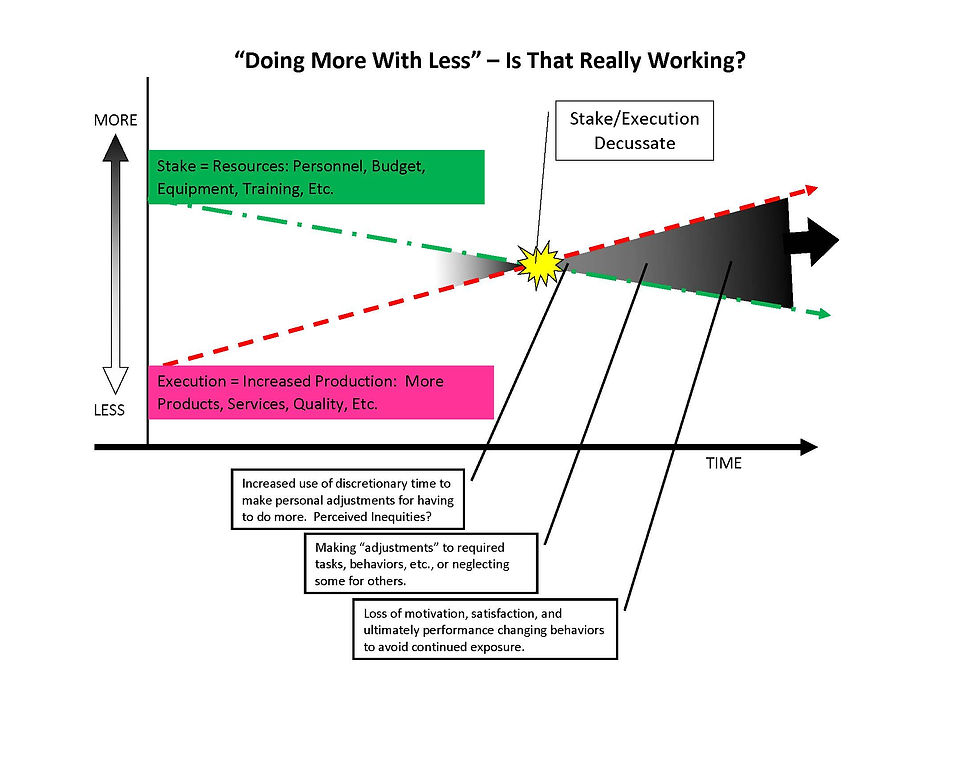
What Dangers? Very similar to the equity theory where people make adjustments when they perceive they are not being treated fairly, in a stake/execution decussate, people will begin making adjustments for the (perceived) changes of having to continue to perform (execution) or even increase performance, although there is less money, training, personnel,(stake), to do it with. The reason this becomes dangerous is that people may begin to become “innovative,” be selective of some tasks, or behaviors over others in order to “complete the more important tasks,” or even just neglect to do tasks just to “make the adjustment,” to a more “normal” way of functioning. This also causes loss of Motivation, Satisfaction and ultimately, Performance.
“Doing More With Less” as a Demotivational Leadership Message
One of the greatest dangers of the phrase “doing more with less” is that it eventually stops sounding motivational and starts sounding dismissive. Employees may initially rise to the challenge during temporary hardship, emergencies, staffing shortages, or organizational crises because people naturally want to help the team succeed. However, when “doing more with less” becomes a long-term organizational philosophy rather than a temporary adaptation, employees often begin to perceive that leadership no longer recognizes the limits of human performance, energy, time, or physiology.
The phrase itself unintentionally communicates an important psychological message:
“The organization expects increased output regardless of whether the resources required to accomplish the work are available.”
Over time, employees begin to recognize that the expectations never decrease, even when staffing, equipment, training, support systems, or available time continue to decline. This creates a dangerous imbalance between demand and capacity. Initially, employees may compensate through increased effort, discretionary time, emotional investment, or personal sacrifice. But eventually, those reserves become depleted.
As noted in the original bulletin, employees begin making “adjustments” to restore equilibrium. These adjustments may include:
Selectively prioritizing certain tasks over others
Reducing quality to maintain quantity
Avoiding initiative-taking behaviors
Emotional disengagement
Increased absenteeism
Burnout and fatigue
Cynicism toward leadership
Quiet quitting or withdrawal behaviors
Resistance to organizational change
Reduced innovation and discretionary effort
Ironically, the very philosophy intended to increase productivity may ultimately reduce organizational effectiveness.
THE MOTIVATION PROBLEM
Motivation is heavily connected to the perception that effort and performance are meaningful, achievable, and fairly supported. When employees repeatedly hear “do more with less,” they may eventually interpret it as:
“No matter how hard we work, it will never be enough.”
“Leadership will continue reducing support while increasing expectations.”
“Our sacrifices are now the operational model.”
This becomes especially dangerous because employees often stop viewing extraordinary effort as temporary and instead begin viewing exploitation as normalized.
At that point, organizations frequently see a decline in:
Organizational commitment
Morale
Trust in leadership
Psychological safety
Initiative-taking behavior
Long-term retention
Employees may still physically show up to work, but psychologically disengage from the mission.
THE LOGICAL ENDPOINT
One of the most important critiques of the “doing more with less” philosophy is its flawed logical trajectory. As originally stated;
“If you follow out that thinking logically, then ultimately we would be able to do everything with nothing.”
This quote captures the unsustainable nature of the mindset. Every system, whether biological, mechanical, financial, or organizational, has thresholds, limits, and capacity boundaries. Human beings are not infinite-output systems. Organizations cannot continuously remove stake (resources) while indefinitely increasing execution demands without consequences emerging somewhere in the system.
Eventually, the costs appear in forms such as:
Turnover
Increased mistakes
Lower quality
Reduced customer service
Safety issues
Health problems
Emotional exhaustion
Interpersonal conflict
Loss of institutional knowledge
Reduced adaptability
In many cases, organizations mistakenly interpret these outcomes as employee attitude problems rather than predictable responses to chronic overload conditions.
THE LEADERSHIP DILEMMA
Leaders often become trapped in this cycle themselves. Many supervisors and managers did not create the resource reductions, yet they become responsible for maintaining performance despite shrinking support systems. This places leaders into a difficult intermediary position between organizational expectations and human limitations.
When leaders simply repeat the phrase “do more with less,” employees may perceive leadership as disconnected from operational reality. However, leaders who openly acknowledge resource limitations while advocating for realistic expectations tend to maintain higher levels of trust and credibility.
Employees do not necessarily expect perfection from leadership. They do, however, expect honesty, realism, advocacy, and recognition of the human cost associated with sustained overload.
A BETTER APPROACH
Rather than focusing on “doing more with less,” organizations may benefit from reframing the conversation toward:
Prioritization
Strategic allocation of resources
Process improvement
Sustainability
Workforce well-being
Capacity management
Mission-critical execution
Organizational resilience
The question should not always be: “How do we do more?” Sometimes the better leadership question is: “What is realistically sustainable with the resources we actually possess?”
PUTTING IT INTO PRACTICE
Effective leadership requires recognizing that people are not machines and that motivation cannot be permanently extracted through pressure alone. Human performance is deeply connected to fairness, support, recovery, trust, and perceived organizational reciprocity.
Temporary sacrifice can unify organizations during crisis. But permanent sacrifice eventually fractures them. The most effective organizations are not necessarily the ones that demand the most output from depleted systems. They are the organizations that understand how to balance execution demands with sustainable human capacity over time.


Comments