


Understanding the Five Stages of Team Development
- Dr. Chris Fuzie
- Feb 5
- 7 min read

When I first stepped into a leadership role, I quickly realized that building a successful team is not just about assembling talented individuals. It’s about guiding them through a journey, a process that shapes how they interact, solve problems, and achieve goals together. This journey is best understood through the lens of the five stages of team development. Knowing these stages can transform how you lead, follow, and collaborate.
Let’s dive into what these stages are, why they matter, and how you can navigate them to build a high-performing team.
Why Knowing Team Development Stages Matters
Have you ever wondered why some teams click instantly while others struggle for months? The answer often lies in where the team is in its development process. Teams don’t start off perfectly aligned. They evolve through phases, each with its own challenges and opportunities.
Understanding team development stages helps you:
Anticipate conflicts and misunderstandings before they escalate.
Foster trust and open communication.
Align team members around shared goals.
Adapt your leadership style to meet the team’s current needs.
Imagine trying to coach a sports team without knowing the rules of the game. It would be chaotic. Similarly, leading a team without understanding its development stages is like navigating without a map.
The Dynamics of Team Growth: What Happens in Each Stage?
Teams are living systems. They grow, change, and mature. Each stage in the team development process has distinct characteristics:
Forming: This is the honeymoon phase. Team members are polite, positive, and eager to learn about each other. Roles and responsibilities are unclear, and people rely heavily on the leader for direction.
Storming: Here’s where the real work begins. Conflicts arise as personalities clash and members challenge authority or the team’s purpose. It’s uncomfortable but necessary for growth.
Norming: The team starts to find its rhythm. Members resolve differences, establish norms, and develop stronger relationships. Collaboration improves, and trust builds.
Performing: This is the sweet spot. The team functions smoothly toward shared goals with minimal friction. Roles are clear, and members are motivated and competent.
Adjourning: Also called the mourning stage, this happens when the project ends or the team disbands. It’s a time for reflection and celebration.
Each phase requires different leadership approaches and team behaviors. Recognizing these shifts can help you steer the team more effectively. In each phase there a three factors that the leader must evaluate; Task, Relationship, and Structure.
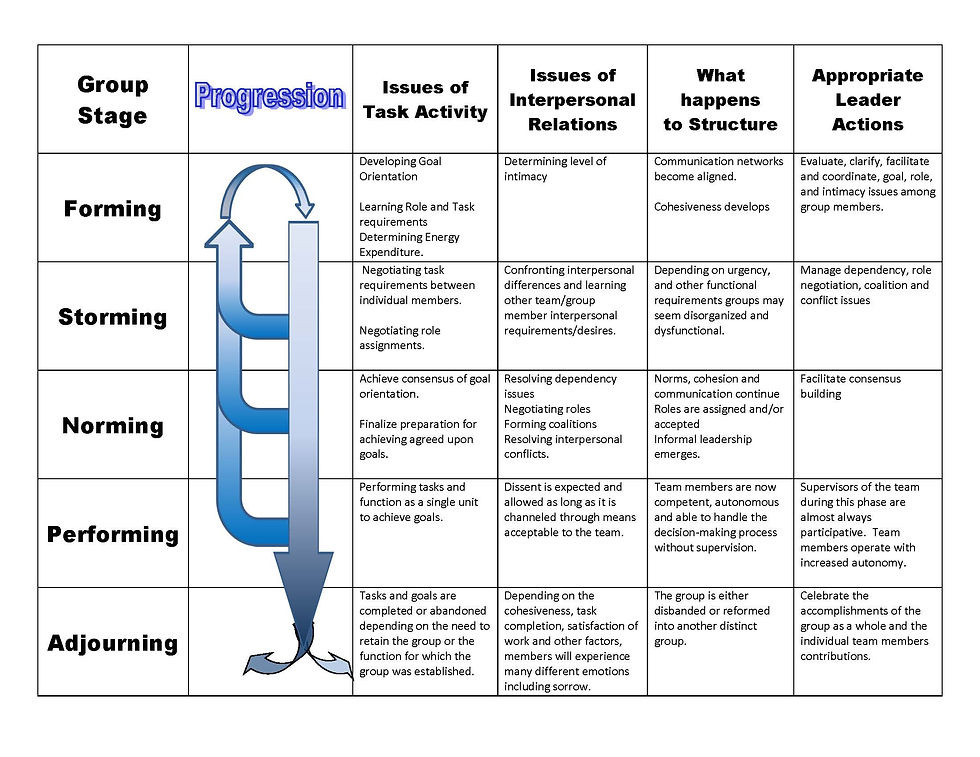
One thing to note is if there are changes to the task, relationships or structure, then the entire team goes back through the stages, beginning with Forming. The team may move quickly back through the other stages, but every time one of those things change plan on going back through the stages.
What are the 5 stages of team development?
Let’s break down the five stages in more detail, with practical examples and tips for each.
1. Forming: The Beginning of Connection
At this stage, everyone is getting to know each other. Think of it as the first day at a new school. People are polite but cautious. They want to make a good impression but aren’t yet comfortable sharing their true thoughts.
Key behaviors:
High dependence on the leader for guidance.
Uncertainty about roles and expectations.
Avoidance of conflict.
Tips for leaders:
Clearly communicate goals and roles.
Encourage open dialogue to build rapport.
Set the tone for respect and inclusivity.
Example: At the start of each "shift change," (team changes) I would meet with each team member individually and then as a whole team and discuss expectations, strengths, weaknesses, opportunities and threats to the team along with our goals for the next few months we would be working together.
2. Storming: Navigating Conflict and Resistance
Storming is often the most challenging phase. Team members test boundaries, challenge ideas, and sometimes clash over priorities or personalities. It’s like a pressure cooker, intense but necessary to release steam and grow. This is the stage where using "S.T.I.C.K.U.M." to help start building team cohesion is most effective to help move quickly through to the "Norming" stage.
Key behaviors:
Conflicts and disagreements surface.
Power struggles or resistance to leadership.
Frustration and anxiety.
Tips for leaders:
Stay calm and neutral during conflicts.
Facilitate open discussions to address issues.
Reinforce the team’s shared purpose.
Use S.T.I.C.K.U.M. methods to build cohesion.
Example: In one team there were two teammates who each had a different focus for their personal efforts, so I created some functional competition (the "C" in S.T.I.C.K.U.M.) for the entire team using the two employees goals for the entire team. This helped the team recognize that both focus areas were helping us achieve the overall goals.
3. Norming: Building Cohesion and Trust
After the storm, teams enter a more stable phase as the tasks are better understood, relationship become more solidified and the structure/communication become more accepted and differences are more tolerated by the others. Norms and standards emerge, and members start to appreciate each other’s strengths and help each other overcome the weaknesses. Collaboration becomes easier, and the team feels more cohesive.
Key behaviors:
Increased cooperation and support.
Clearer roles and responsibilities.
Constructive feedback and problem-solving.
Tips for leaders:
Celebrate small wins to boost morale.
Encourage shared decision-making.
Continue fostering open communication.
Example: When we went to different teams there was a different "pecking order" to where people sat in the briefing room, so the norm was established using seniority, first pick of seats and then up to the newest employee last pick.
Frequently, teams feel they are in the "Performing" stage, however there is more reliance on the leader to monitor the team interactions, tasks or structural issues have not yet settled.
4. Performing: Achieving High Performance
This is the stage every team strives for. Members work efficiently and effectively toward common goals. They are motivated, skilled, and able to handle complex tasks with minimal supervision. Frequently, the team leader acts more as a teammate than a supervisor and may yield some of their authority to the team. In this stage there still may be conflict, but the conflict is to determine the best outcome for the team.
Key behaviors:
High autonomy and collaboration.
Focus on achieving results.
Flexibility and adaptability.
Tips for leaders:
Delegate authority and empower team members.
Provide resources and remove obstacles.
Recognize and reward achievements.
Example: While preparing an operations plan to serve a high-risk search and arrest warrant the team was having a heated argument about who should be in what positions at the approach and during the service of the warrants based on the different skills each team member held. In the middle of the group was the supervisor just listening and also chiming in as one of the team. I walked in because I heard the argument and saw the supervisor in the middle of the group. I asked the supervisor to step out and talk with me. When he came out I asked him what they were arguing about and he looked at me like I didn't understand and said, "Boss, were just working out the ops plan, were not arguing, we're just trying to decide the positions." I left the supervisor to go back into the meeting and as I closed the door, I heard the raised voices and back/forth discussion continue. The operations plan was very well planned out and executed like a charm.
When you get a team in this phase...only intervene as needed. Let the autonomy help continue to build the teams cohesion, and reinforce the task, relationship and structure they've already built.
5. Adjourning: Reflecting and Moving On
When a project ends or the team disbands, adjourning is about closure. It’s a time to reflect on accomplishments, lessons learned, and say goodbye.
Key behaviors:
Mixed emotions, including sadness or relief.
Reflection on successes and challenges.
Planning for future transitions.
Tips for leaders:
Organize a debrief or celebration.
Encourage feedback and documentation.
Support members in their next steps.
Example: After completing a year-long initiative, I facilitated a team retrospective where we shared stories, recognized contributions, and discussed how to apply lessons to future projects.

How to Apply This Knowledge in Real Life
Understanding these stages is one thing, but applying them effectively is where the real impact happens. Here are some actionable recommendations:
Assess your team’s current stage regularly. Ask yourself: Are they still figuring things out, or are they firing on all cylinders?
Adapt your leadership style to fit the stage. Early on, be directive and supportive. Later, empower and delegate.
Encourage open communication at every phase. Create safe spaces for honest feedback.
Invest in team-building activities that match the team’s needs. Icebreakers for forming, conflict resolution workshops for storming, and goal-setting sessions for norming.
Celebrate progress to keep motivation high, especially during norming and performing.
Plan for transitions by preparing the team for adjourning and future projects.
By intentionally guiding your team through these phases, you can reduce friction, boost morale, and accelerate performance.
The Bigger Picture: Why Team Development is a Leadership Imperative
In today’s fast-paced world, organizations rely heavily on teams to innovate and execute strategies. The ability to understand and manage the stages of team development is a critical leadership skill. It’s not just about managing tasks but about nurturing relationships and dynamics that drive success.
Remember, every team is unique. The journey through these stages may be quick or slow, smooth or turbulent. Your role is to be the steady hand that helps the team navigate this path with confidence and clarity.
If you want to dive deeper into the stages of team development, I highly recommend exploring resources that offer practical tools and frameworks tailored to your specific context.
Mastering these stages will empower you to build resilient, high-performing teams that can meet any challenge head-on.
By embracing the five stages of team development, you’re not just managing a group—you’re cultivating a thriving community of collaborators ready to achieve extraordinary results.


Comments